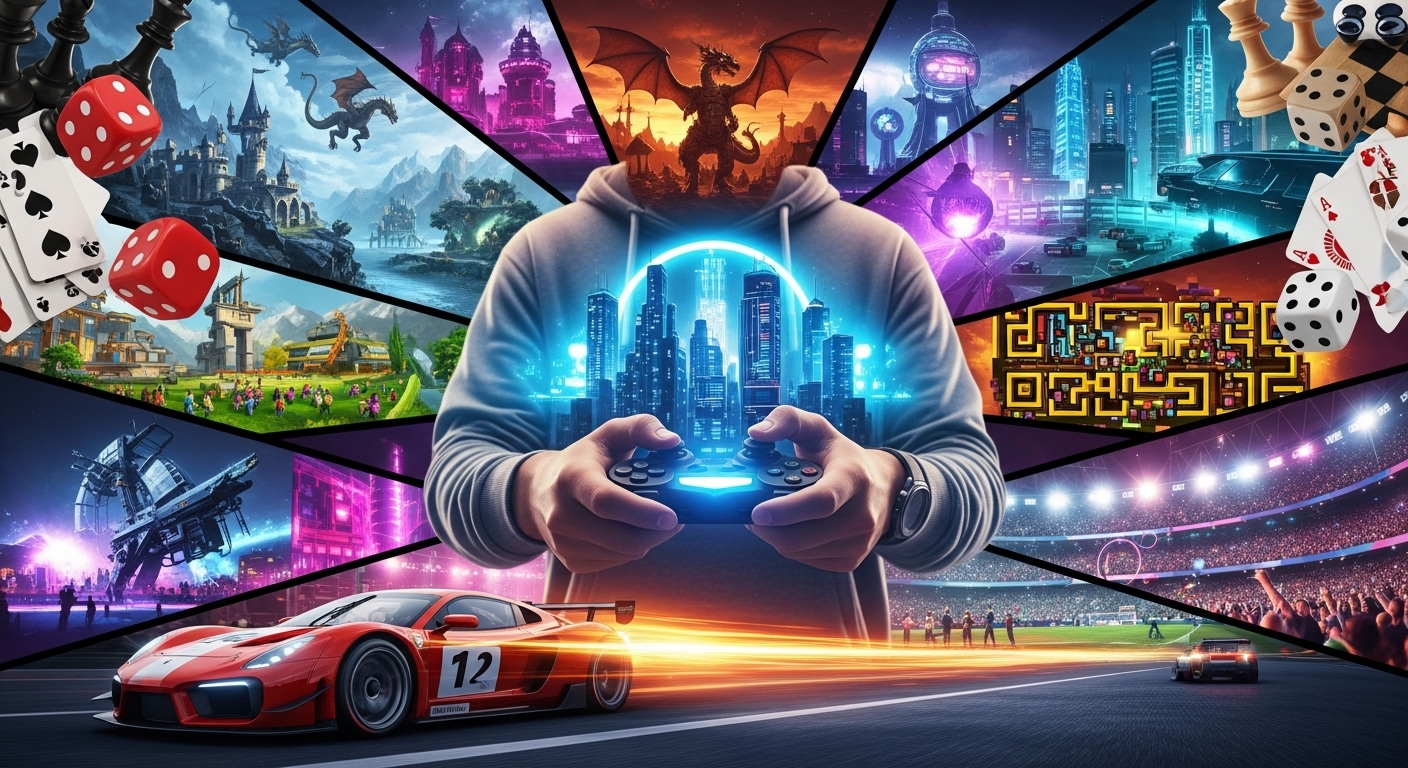

Video gaming, once a niche hobby for a small group of enthusiasts, has exploded into one of the most influential and lucrative industries in the world. Today, video games are more than just a pastime; they are a massive cultural and economic force that spans generations, social groups, and even continents. In this post, we’ll dive into the rich history of video gaming, its technological advances, the rise of esports, and the future of gaming in the modern world.
The Humble Beginnings: The Birth of Video Games
Early Beginnings in the Laboratory
The history of video games dates back to the 1950s, when early pioneers began exploring the idea of using computers for interactive entertainment. The first notable attempt came in 1958 when physicist William Higinbotham created Tennis for Two. This was a simple game displayed on an oscilloscope, where two players used paddles to hit a ball back and forth, similar to modern-day Pong. It was a rudimentary form of interactive entertainment, but it showed that technology could be used for more than just scientific calculations.
The real breakthrough came a few years later in 1962 when Steve Russell, a student at MIT, created Spacewar!, the first widely recognized video game. Spacewar! featured two spaceships battling each other in a 2D starfield, and it became the prototype for the video game industry. It was one of the first games to be shared and played across multiple computers at universities and research labs, helping spark the interest in video gaming as a potential form of entertainment.
The Birth of Arcades
The true dawn of the video game industry came in 1972 when Atari, founded by Nolan Bushnell, released Pong, the first commercially successful arcade game. Pong was simple: players controlled paddles that bounced a ball back and forth, simulating a game of table tennis. However, its simplicity made it addictive and entertaining. Pong was an instant hit, quickly becoming a cultural phenomenon and leading to the creation of arcade video game culture.
The success of Pong and its arcade counterparts such as Space Invaders (1978) and Pac-Man (1980) fueled the growth of the gaming industry. Arcades became hubs for young people to socialize, compete for high scores, and enjoy a new form of entertainment. These early games had a simple but captivating appeal, using catchy sounds, bright visuals, and rewarding gameplay loops that still resonate in modern gaming.
The Rise of Home Consoles: Revolutionizing Gaming
The Shift to Home Entertainment
While arcades were thriving, home gaming consoles were still in their infancy. In 1977, Atari introduced the Atari 2600, which was the first major home console to gain widespread attention. The Atari 2600 allowed players to play video games at home using interchangeable cartridges, an idea that was revolutionary at the time. Popular games like Space Invaders and Asteroids were ported to the Atari 2600, offering players a taste of the arcade experience without leaving their homes.
This shift to home gaming sparked a cultural change, as families began to enjoy gaming together, and children could now play their favorite games on demand. However, the early success of home consoles was followed by a crash in the video game market in 1983, when an oversaturation of poor-quality games and consoles led to a dramatic decline in sales.
The Resurgence: Nintendo and Sega
The video game industry recovered in the mid-1980s, largely thanks to Nintendo. In 1985, Nintendo launched the Nintendo Entertainment System (NES), which helped reinvigorate the gaming market. With games like Super Mario Bros., The Legend of Zelda, and Metroid, Nintendo proved that video games could be much more than simple entertainment—they could tell complex stories, offer intricate gameplay, and appeal to a broad audience. The success of the NES solidified Nintendo’s position as a leader in the video game industry.
At the same time, Sega emerged as a formidable competitor. In 1988, Sega launched the Sega Genesis, which was marketed as a more powerful system than the NES, with faster processing power and better graphics. The launch of iconic franchises like Sonic the Hedgehog helped Sega carve out its niche in the gaming market. The rivalry between Nintendo and Sega during this period, known as the “Console Wars,” would shape the gaming landscape for the next several decades.
The 3D Revolution: Shaping the Future of Gaming
The Advent of 3D Gaming
The 1990s marked the beginning of the “3D revolution” in video games, transforming the way games were developed and played. The arrival of the Sony PlayStation in 1994, along with the release of the Nintendo 64 in 1996, introduced fully immersive 3D environments that revolutionized the gaming experience. The PlayStation, with its powerful hardware, allowed developers to create expansive 3D worlds, offering games with more complex narratives, innovative gameplay mechanics, and greater visual fidelity than ever before.
The launch of the Nintendo 64, with groundbreaking titles like Super Mario 64 and The Legend of Zelda: Ocarina of Time, demonstrated how 3D worlds could provide a new level of freedom and exploration. These games featured vast, open environments and sophisticated controls that made the player feel like they were truly part of the game world.
The Rise of PC Gaming
While consoles were making the leap into 3D, the PC gaming world was also evolving. The late 1990s and early 2000s saw the rise of real-time strategy (RTS) games, first-person shooters (FPS), and massively multiplayer online games (MMOs), genres that became central to PC gaming culture.
Doom (1993), developed by id Software, was one of the first games to introduce fast-paced FPS action, and it set the stage for future FPS titles like Quake (1996) and Half-Life (1998). These games focused on multiplayer experiences, laying the groundwork for modern competitive online gaming.
The advent of MMOs such as World of Warcraft (2004) also expanded the possibilities of gaming, offering players the opportunity to interact with thousands of others in a persistent, online world. These games brought social gaming to the forefront, where players could form guilds, trade items, and take part in large-scale raids.
The Explosion of Online Gaming and Esports
The Birth of Online Gaming
The early 2000s saw the explosion of online gaming, which allowed players to connect with one another across the globe. Broadband internet made it easier to play games online, and platforms like Xbox Live and PlayStation Network introduced seamless online multiplayer experiences for consoles.
Online gaming quickly became a cultural force. Popular multiplayer games like Halo 2 (2004), Call of Duty 4: Modern Warfare (2007), and Counter-Strike (1999) allowed players to compete against others in fast-paced matches. The competitive nature of these games led to the birth of esports—professional competitive gaming.
The Rise of Esports
Esports is now a multi-billion dollar industry, with professional players, teams, tournaments, and global audiences. Games like League of Legends, Dota 2, and Fortnite have all contributed to the rise of esports, where players compete for huge prize pools, sponsorships, and fame. Esports has grown to the point where it is broadcast on television networks and streamed to millions of viewers worldwide via platforms like Twitch and YouTube Gaming.
Esports has become a cultural phenomenon, with massive tournaments like The International (Dota 2) and League of Legends World Championship drawing in audiences that rival traditional sports events. Additionally, universities and schools now offer scholarships for aspiring esports athletes, making professional gaming a viable career path for talented players.
Mobile Gaming and the Explosion of Accessibility
The Rise of Smartphones
The mobile gaming market experienced explosive growth in the late 2000s and 2010s, thanks to the advent of smartphones and app stores. In 2007, Apple’s release of the iPhone ushered in a new era of gaming, with easy access to millions of players through the App Store. Games like Angry Birds, Candy Crush Saga, and Clash of Clans became household names, demonstrating that gaming could be casual, accessible, and enjoyed on the go.
Mobile gaming opened up the world of gaming to a much broader audience. While console gaming and PC gaming had been dominated by a relatively small group of enthusiasts, mobile gaming reached people who had never considered themselves gamers. With simple gameplay mechanics, colorful graphics, and quick play sessions, mobile games were easy to pick up and enjoy at any time.
Free-to-Play and Microtransactions
The mobile gaming market also popularized the free-to-play (F2P) model, which revolutionized how games were monetized. In the F2P model, games are free to download, but players are encouraged to make in-app purchases for cosmetic items, power-ups, or extra content. Games like Fortnite and Pokémon GO have been highly successful using this model, with millions of players spending money on optional in-game items.
This shift has led to a change in how video games are sold and how developers make money. While traditional games required an upfront purchase, the F2P model relies on microtransactions and the idea of offering a game for free to as many players as possible, then monetizing through optional purchases.
The Future of Gaming: Where Are We Headed?
Cloud Gaming: The Next Frontier
Looking forward, the future of gaming seems poised to embrace cloud gaming. With services like Google Stadia, Xbox Cloud Gaming, and NVIDIA GeForce Now, players can stream games directly from the cloud to their devices, bypassing the need for high-end gaming PCs or consoles. Cloud gaming has the potential to democratize access to the latest games, as players will only need a device with a stable internet connection to enjoy high-quality gaming experiences.
Virtual Reality and Augmented Reality
Another frontier in gaming is virtual reality (VR) and augmented reality (AR). VR has already made waves with products like the Oculus Rift and PlayStation VR, offering players a fully immersive gaming experience. However, VR gaming is still in its early stages, and there’s much more potential for growth as technology improves.
Augmented reality, as seen with Pokémon GO, allows players to interact with digital elements in the real world. Future AR games could allow for experiences that blend the physical and digital worlds in ways we can only imagine.
Conclusion: Gaming’s Lasting Impact on Culture and Society
Video gaming has come a long way from its early origins in research labs to its present-day status as a global entertainment powerhouse. Along the way, it has influenced culture, brought people together, and become a force for social and technological change. The next frontier of gaming is incredibly exciting, with cloud gaming, VR, and AR offering new possibilities for how we experience games. Whatever the future holds, one thing is certain: video games are here to stay.